During my talks on mental health in the workplace, I often use Mentimeter to ask questions from the audience. Over the coming months, I plan to write a series of blog posts that explore the responses to these questions, and what it can tell us about the state of mental health in the research software community.
In this first post, I will look at the Mentimeter Insights from each talk. I gave six in-person or online talks where I asked the audience to respond to two questions:
- “What are the biggest challenges/barriers you face when it comes to mental health in the workplace?”
- “Do you have any tips for managing your mental health, or examples of things that good line managers do to support their team?”
141 people gave 229 responses to the first question and 289 responses to the second.
After each of the six events, Mentimeter provided a trio of AI-generated ‘insights’, highlighting the most common responses to these questions. An example of these insights is shown below, and I have tried to summarise the common threads across all six events in the rest of this post.
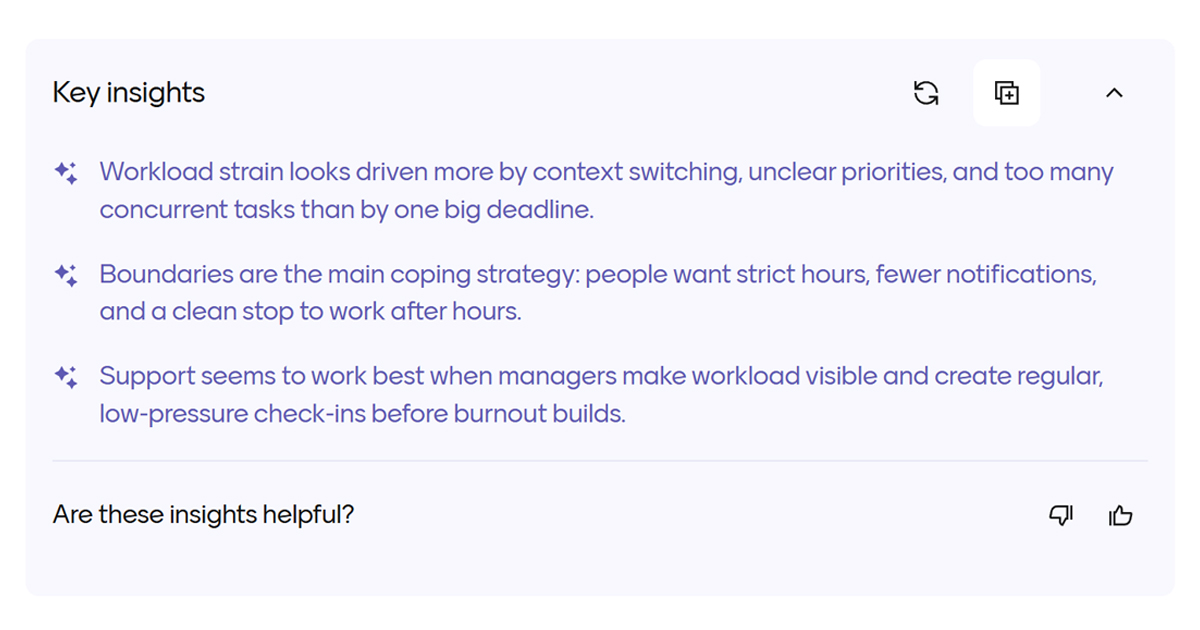
I am very aware that these insights are AI-generated, and that some people will have strong feelings about that. AI is one of the most common anxieties in the research software community right now. I wrote this post based on the Mentimeter Insights, correlated with the conversations I’ve had over the last year.
Common Issues
These are common threads that stood out to me in the Mentimeter Insights across all six events.
Workload
Across every group, the primary source of stress and anxiety is not the actual work, but the stuff that surrounds it.
- Overload and rising expectations are common complaints. Many respondents talk about taking on additional responsibilities that are not part of their core role.
- It is not just the volume of work that is a problem, but the nature of it. The most common complaints are “context switching”, “too many meetings”, and “unclear priorities”.
- A lack of agency over their time is frequently cited as a major source of frustration.
Boundaries
When asked what helps them cope, participants consistently point to firm boundaries. This can mean setting clear boundaries between work and personal life, including communication boundaries, as I discussed in a recent blog post.
- Time Management: Strategies like ‘timeboxing’ (allocating a maximum amount of time to an activity) and protecting focus time.
- Digital Disconnect: There is a strong desire for clear “off-switches,” such as limited notifications and protected hours, to allow for better focus and recovery.
- The Art of Saying “No”: Empowerment to decline work (‘optional’ tasks in particular) or to set realistic deadlines.
Leadership
I has often discussed the vital role that leadership plays in mental health in the workplace, as have many other people. The Mentimeter insights reflect this: participants are looking for their leaders be more aware and inclusive, but also for tangible action.
- Managerial Action: There is a call for managers to be proactive; making workloads visible, intervening before burnout and normalizing the setting of boundaries.
- Social Support: Feelings of isolation are common. Teams that foster belonging—through informal coffee chats, peer support and “safe” check-ins—report higher satisfaction and lower strain.
- Role Clarity: Especially in volunteer or specialized roles, there is a risk of emotional labour becoming a hidden burden; clear expectations are the antidote.
It is also important to lead by example. It is not helpful to see managers working long hours, sending emails at all hours, or working when they are supposed to be on leave. It also helps to create a sense of psychological safety if managers openly discuss and encourage conversations around mental health, and are transparent when they take mental health days themselves.
Themes
I’ve tried to identify the main themes that came up over and over again in these insights, as well as the solutions to those challenges that were proposed by the community.
Workload:
- Insight: Context switching & unclear goals might be considered part of the role of an RSE, but they can drive stress if not managed carefully.
- Solution: Protected focus time & clear priority setting.
Boundaries:
- Insight: Overwork is the default; downtime is scarce. Particularly when you’re working on research projects that will benefit society in some way, it can be hard to keep a professional distance. RSEs also seem particularly prone to hoarding leave over taking time of to look after themselves.
- Solution: Timeboxing & “switching off.”
Management:
- Insight: Employees feel unsupported by passive leadership. It is not enough to have a monthly meeting where you check on the progress of your reports’ project work.
- Solution: Proactive, visible manager-led check-ins, with a focus on mental health and well-being.
Culture:
- Insight: Isolation exacerbates workplace strain. Since 2020, many RSEs have been working from home more frequently, and this can lead to feelings of isolation and disconnection from colleagues. Similarly, RSEs who are embedded in other research groups may feel isolated from their peers,.
- Solution: Peer support & informal social connection.
A Counterpoint
The insights described above do not represent the full spectrum of experiences reported in the survey.
For example, feelings of isolation are mentioned twice above. However, it has to be said that while some people do feel isolated, and it may be better for them to come into the office and have more social connections, there are others who prefer to work from home and maintain more of a distance from their work.
Similarly “Pub!” is one of the most common responses to Question 2. However, many people do not drink alcohol for a variety of reasons, and so you may have to be more creative about how to organise inclusive social events. You might also need to consider how your team selects social venues where food or alcohol may be involved.
This is a reminder that there is no one-size-fits-all solution and that what works for the majority may not work for everyone.
Final Thoughts
So, that’s a first look at the data collected from the Mentimeter survey. A lot of these insights and themes reflect the conversations that I had with people through my SSI Fellowship.
For me, the takeaway is clear: Mental health is a workplace design issue. While individual coping strategies (like hobbies or self-care) are helpful, the you cannot overstate the importance of leadership adn workplace culture. We need to do a better job of managing workloads, protecting focus time and life/work balance, and leaders need to be more active in setting a good example and supporting their teams.
…
I plan to share the data, once it has been cleaned and anonymised. A deeper dive into this data will follow in future posts, once I’ve found the time to do it (and worked out how to process qualitative data effectively without relying on AI!).
