<?xml version="1.0" encoding="utf-8"?><feed xmlns="http://www.w3.org/2005/Atom" ><generator uri="https://jekyllrb.com/" version="4.3.4">Jekyll</generator><link href="https://converse.mdsimpson.co.uk/feed.xml" rel="self" type="application/atom+xml" /><link href="https://converse.mdsimpson.co.uk/" rel="alternate" type="text/html" /><updated>2026-06-18T19:44:36+00:00</updated><id>https://converse.mdsimpson.co.uk/feed.xml</id><title type="html">ConveRSE</title><entry><title type="html">Having “The Talk”</title><link href="https://converse.mdsimpson.co.uk/2026/03/20/having-the-talk.html" rel="alternate" type="text/html" title="Having “The Talk”" /><published>2026-03-20T00:00:00+00:00</published><updated>2026-03-20T00:00:00+00:00</updated><id>https://converse.mdsimpson.co.uk/2026/03/20/having-the-talk</id><content type="html" xml:base="https://converse.mdsimpson.co.uk/2026/03/20/having-the-talk.html"><![CDATA[<p>A question I get asked regularly when I give my <a href="/talks.html">mental health talk</a>
is “If I’m struggling, how do I start a conversation with my line manager?” This has proved to be
one of the hardest questions to answer, so I’ve resorted to asking the community for help.</p>

<p>In this blog post, I will discuss some of the suggestions that have come up, as well as asking
more questions about how to deal with the problem from both sides of the 1-to-1 meeting table.</p>

<hr />

<p><strong>Content warning: This post briefly mentions suicide.</strong></p>

<p>It feels like there are a few different facets to this problem. First, let’s try to tackle
the question head on, before we look at the wider problem and how we might go about
solving it.</p>

<h2 id="asking-for-help">Asking for Help</h2>

<p>As part of the ConveRSE project, I’ve been encouraging people to talk more openly about
mental health in the workplace. I’ve gone to great lengths to explain why it’s important,
and that everyone benefits when we do. I’ve also explained that it leads to more productivity
and saves the company money in the long run, as it is always easier and cheaper to prevent
issues from turning into bigger problems than it is to fix them afterwards.</p>

<p>But I also acknowledge that admitting that you’re struggling and asking for help is difficult.
I know how daunting it can be to start that conversation, and what it feels like to worry
that your admission will be seen as a sign of weakness, or that it may affect your career.</p>

<p>But I’ve also stood up in front of a dozen rooms full of strangers and told them about
I had an anxiety attack. I know how hard it is. But I also know that it’s worth doing!</p>

<h2 id="having-the-talk">Having The Talk</h2>

<p>Your line manager should be having regular meetings with you, if for no other reason than
to check that everything is going OK with your projects. Ideally, your line manager should
be asking questions in those meetings about how you are and whether your struggling. This is
an opportunity to not just say “yeah, fine,” but to be honest with them.</p>

<p>If they aren’t presenting these opportunities, then you’re faced with steering the conversation
in the right direction. How do you do that? Well, here are some suggestions from the community,
submitted via the <strong>#mental-health channel</strong> on the Society of RSE Slack workspace and during the
Q&amp;A sessions of my talk.</p>

<h2 id="other-ways-to-raise-the-issue">Other Ways to Raise the Issue</h2>

<p>Interestingly, people have suggested a few other ways that you can show that you’re struggling.</p>

<p>Someone at UKAEA told me that they have a toy elephant in their desk drawer, and that they put it
on their desk or on top of their monitor. Their colleagues know that if they can see the elephant,
it means that the person is struggling and to give them some space. (It could also be a sign to
their line manager or a Mental Health First Aider that they need to have a conversation with that
person - particularly if the elephant has been there for a few days!).</p>

<p>Similarly, another suggestion was to set a custom status on Slack (or whatever tool your team
uses to communicate). Some people have a “quiet mode”, if they’re feeling overwhelmed, where
notifications are turned off, so no-one can disturb their concentration, but also people can
see that the person doesn’t want to be disturbed.</p>

<p>Eli Chadwick pointed out that:</p>

<ul>
  <li><em>“Being more open helps encourage your colleagues to be more open (even if you don’t give any
detail and just say e.g. “I’m taking a mental health day this afternoon”). I’ve been a lot more
comfortable discussing &amp; taking time off for mental health when that behaviour has been modelled
by leadership.”</em></li>
</ul>

<h2 id="psychological-safety">Psychological Safety</h2>

<p>We can also look at this from the other side. Should it be the employee’s responsibility to start
these difficult conversations?</p>

<p>Ideally, you want to create phycological safety within your team. And this comes mainly from
having these very visible conversation around mental health. This is why we created the ConveRSE
Leaflets (which you can download from <a href="/resources/downloads">our resources page</a>),
and why we’re working on a poster to share resources and encourage people to continue the conversation.
By talking visibly about it, raising awareness of the issues and doing what we can to
prevent issues and signpost resources, we keep the conversation going, break the stigma
and encourage people to be more open about raising issues and asking for help.</p>

<p>Eli also made the point that:</p>

<ul>
  <li><em>“It’s very hard to be vulnerable with your line manager if your line manager is never vulnerable
with/around you (not necessarily about mental health in particular, but sharing hobbies/personal
opinions/that sort of thing too).”</em></li>
</ul>

<h2 id="line-managers">Line Managers</h2>

<p>I also think that line managers need to make the time to ask questions, particularly if they
suspect that someone is struggling. Again, it can be a difficult conversation, but early
intervention always produces the best outcomes. You do have to ask, and that sometimes
means being asking very clear and direct questions. During Mental Health First Aider training,
we were told that if we suspect someone is thinking of taking their own life, then asking the direct
question is the best way to start a conversation that could save someone’s life.</p>

<p>As them how they’re doing. Ask if they’re managing the workload. And note their responses. If they
repeatedly say they are struggling to stay on top of everything, then some form of support or
intervention may be necessary.</p>

<p>Will Furnass suggested:</p>

<ul>
  <li><em>“Start 1:1s by asking how someone is in general, not by jumping straight to asking for status
reports. My current line manager has been great here, and it’s allowed us to identify and focus
on wellbeing quickly where needed.”</em></li>
</ul>

<p>The most important thing is that you listen, be understanding and provide what support you can.
I know myself how frustrating it can be - and how much worth your mental health gets -
if you admit that you’re struggling, only to feel like your concerns are being ignored,
dismissed or not taken seriously.</p>

<h2 id="other-resources">Other Resources</h2>

<p>As with much advice on this blog, I think its important for everyone - individuals and line
managers/leaders - to be aware of what support is available. It won’t always be possible to
move deadlines or resources around to support someone. And line managers are people too.
They can become overwhelmed at times, and may be unable to offer support even if they wanted to.</p>

<p>There is other support available, such as Mental Health First Aiders, Occupation Health
and the Employee Assistance Programme. That last one is one we’ve been trying to raise awareness
around. A lot of people don’t know that this service is available at most universities, institutions
and large companies, providing free support and therapy sessions, and people can self-refer, so your line
manager doesn’t even need to know that you’re using it.</p>

<p>As a line manager, you should be aware of these services, and be willing to refer your employees
to these services, or encourage them to self-refer when they can.</p>

<h2 id="final-thoughts">Final Thoughts</h2>

<p>So, I really feel that this blog post has… well… pretty much failed to answer a pretty important
question about discussing mental health in the workplace! But hopefully we’ve given a few
useful starting points, and we hope that individuals and managers have a better idea of
how to start these conversations and what support is available.</p>

<p>If you have any suggestions for how to have these conversations, as either an employee or
as a line manager, please consider filling in <a href="https://forms.gle/dQqETajTBdq3Bqaw9">this form</a>.
We will take your responses and use them to create another blog post or resource on this site
based on your feedback. Thank you!</p>

<p><em>Update: Eli Chadwick and I put together a proposal for a hack day project at Collaborations
Workshop 2026 to create resources to help facilitate these conversations. We plan to continue
to work on this project and to share the resource we create with the community. Please consider
filling in the form linked above to help us. Thank you!</em></p>

<hr />

<p><em>Note: I have tried to give credit to the people who made certain comments and suggestions.
However, some of them came anonymously via Mentimeter, and others were made in the room and I
forgot to note who said them, so apologies in advance if you haven’t been given credit for the
thing you said!</em></p>

<p><em>Photo by <a href="https://unsplash.com/@mkvandergriff?utm_source=unsplash&amp;utm_medium=referral&amp;utm_content=creditCopyText">Maranda Vandergriff</a> on <a href="https://unsplash.com/photos/gray-laptop-computer-7aakZdIl4vg?utm_source=unsplash&amp;utm_medium=referral&amp;utm_content=creditCopyText">Unsplash</a></em></p>]]></content><author><name>mike_simpson</name></author><category term="self-care" /><category term="self_care" /><category term="leadership" /><summary type="html"><![CDATA[A question I get asked regularly when I give my mental health talk is “If I’m struggling, how do I start a conversation with my line manager?” This has proved to be one of the hardest questions to answer, so I’ve resorted to asking the community for help.]]></summary><media:thumbnail xmlns:media="http://search.yahoo.com/mrss/" url="https://converse.mdsimpson.co.uk/maranda-vandergriff.jpg" /><media:content medium="image" url="https://converse.mdsimpson.co.uk/maranda-vandergriff.jpg" xmlns:media="http://search.yahoo.com/mrss/" /></entry><entry><title type="html">Top Issues and Solutions from the Research Software Community</title><link href="https://converse.mdsimpson.co.uk/2025/11/19/issues-and-solutions.html" rel="alternate" type="text/html" title="Top Issues and Solutions from the Research Software Community" /><published>2025-11-19T00:00:00+00:00</published><updated>2025-11-19T00:00:00+00:00</updated><id>https://converse.mdsimpson.co.uk/2025/11/19/issues-and-solutions</id><content type="html" xml:base="https://converse.mdsimpson.co.uk/2025/11/19/issues-and-solutions.html"><![CDATA[<p>As part of the ConveRSE project, I’ve been using Mentimeter to collect data from attendees of my
<a href="/talks">“Let’s Talk About Mental Health” talk</a>.</p>

<p>Most of this data was collected at RSECon25 and during a recent visit to the Research
Engineering Group at the Alan Turing Institute in London (you can read more about that in
my recent <a href="https://www.software.ac.uk/fellowship-programme/mike-simpson">blog post</a> on the SSI website).</p>

<hr />

<h2 id="the-questions">The Questions</h2>

<p>At the end of each talk, I switch over to Mentimeter - an interactive tool that allows the audience to use their
phones or laptops to respond anonymously to questions from the presenter.</p>

<p>I ask the audience two questions:</p>

<ol>
  <li>What are the biggest challenges/barriers to your mental health in the workplace?</li>
  <li>Do you have any tips or advice for managing your mental health, or any good examples of things people have done to
support the wellbeing of their teams?</li>
</ol>

<p>The first question helps us understand the most common issues, which tells us where we should focus the efforts
of the ConveRSE project. The second question is potentially more interesting, if harder to answer. I was hoping
to collect some good tips and advice - for individuals and for leaders - that we can feed back into
future conversations, talks and blog posts.</p>

<h2 id="the-data">The Data</h2>

<p>So, was that the case? Well, let’s take a look at the data.</p>

<h3 id="participation-and-responses">Participation and Responses</h3>

<p>First, some context:</p>

<ul>
  <li>108 participants logged on to Mentimeter across multiple talks.</li>
  <li>Each question received responses from around 87% of the participants.</li>
  <li>Participants can submit multiple responses to each question. We got 128 responses to Question 1 and 197
responses to Question 2.</li>
</ul>

<h3 id="analysis">Analysis</h3>

<p>So far, we have only been able to do basic analysis on the data. The responses were free text, so the data is qualitative.
To do this initial review of the data, I have taken two approaches:</p>

<ol>
  <li>Using Power BI, I created a Word Cloud for each question. This is essentially a count of how many times each word was used.
(This is how the visual used in the thumbnail of this blog post was created.)</li>
  <li>I have attempted to categorise the submissions and amalgamate them, as described below.</li>
</ol>

<p>Each response was assigned a number of categories. For example:</p>

<ul>
  <li>Amalgamating different spellings (“impostor syndrome” and “imposter syndrome”).</li>
  <li>Combining similar advice: (lots of people mentioned “fresh air”, “nature”, “touching grass” or “get outside”).</li>
  <li>Separating multiple responses. For example, one response was: “Yoga, Work from home more often, Team lunch on pay day,
No work on weekends”, which was assigned four categories.</li>
</ul>

<p>There is more work to be done, but this initial processing has allowed us to take a look at common responses
to each question.</p>

<h2 id="question-1">Question 1</h2>

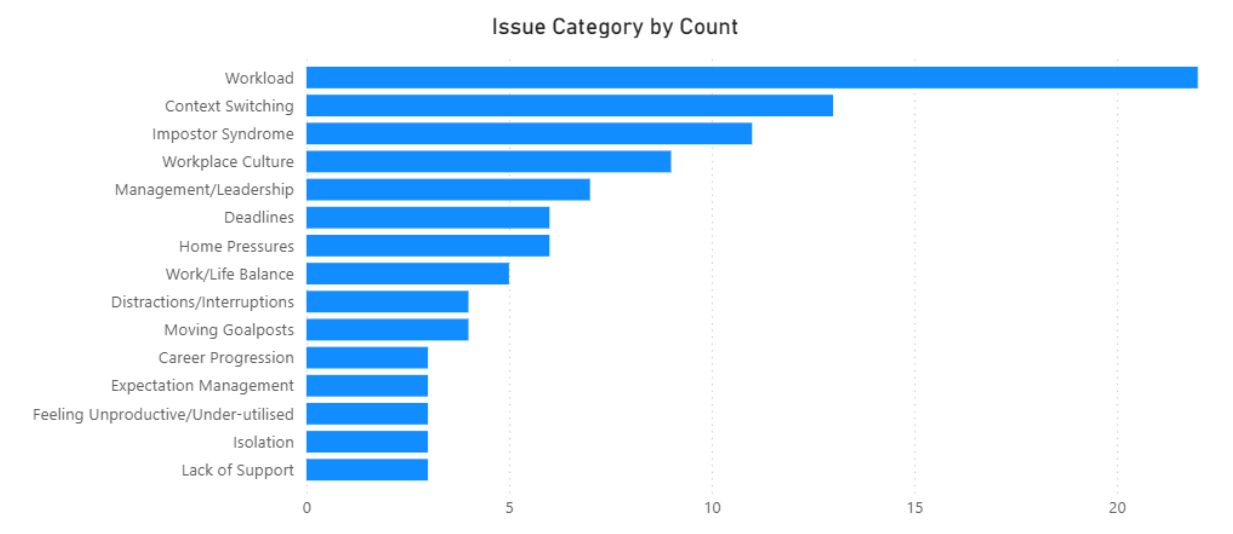
<p>Question 1 was “What are the biggest challenges/barriers to mental health in the workplace?” The graph below shows
the number of times each of the most common issues was mentioned.</p>

<p><img src="/assets/img/blog/question-one.jpg" alt="A graph showing the number of times that each challenge or barrier was mentioned in response to question one of the survey." /></p>

<p>The three most reported issues were: Workload (22 responses), Context Switching (13) and Impostor Syndrome (11).
These are common issues that have cropped up in so many conversations over the last few months. You could argue
that these are just part of everyday life for RSEs, but there must also be more that we can do to mitigate these
issues or support people who are struggling with them.</p>

<p>The next two most reported issues were Workplace Culture (9) and Management/Leadership (7). This just goes to show how
important leaders and line managers are, both in supporting individuals and in supporting their teams.</p>

<p>This data seems to support my current conclusions from my Fellowship so far:</p>

<ol>
  <li>Self-care is important, and we need to provide people with the information, support and tools they need to look
after themselves.</li>
  <li>We need to give leaders and line managers the tools they need to manage not just the projects and workload of their teams,
but the morale and wellbeing too.</li>
</ol>

<h2 id="question-2">Question 2</h2>

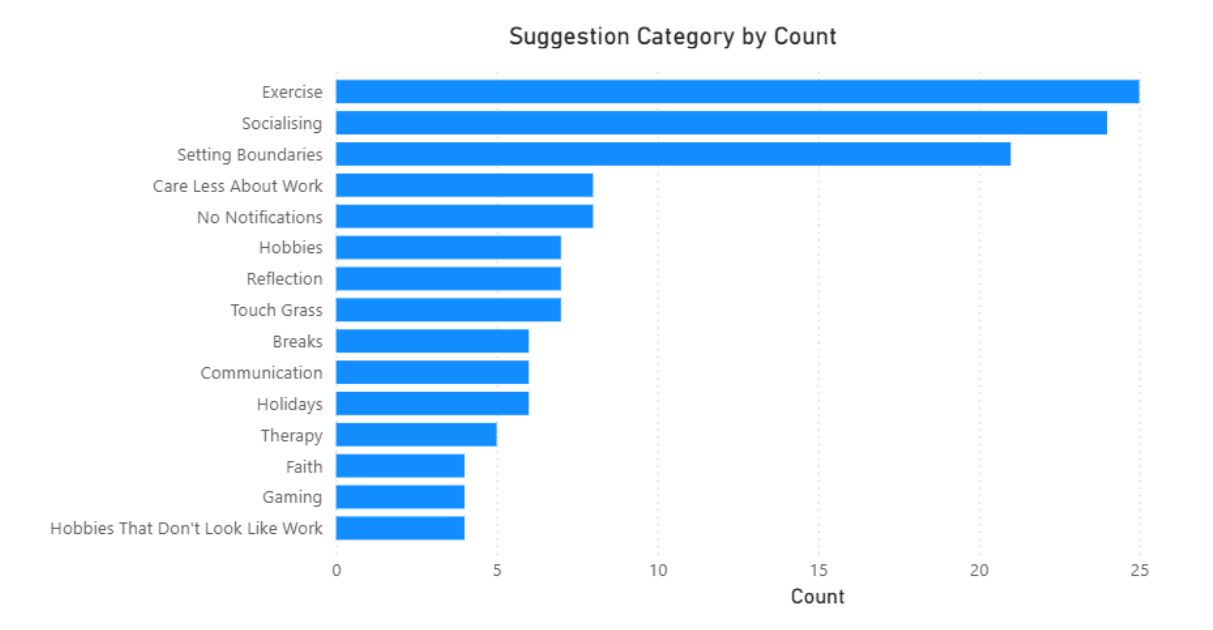
<p>Question 2 was “Do you have any tips or advice for managing mental health or any good examples of things people have done
to support the morale of their teams?”. The graph below shows the number of times each suggestion was made.</p>

<p><img src="/assets/img/blog/question-two.jpg" alt="A graph showing the number of times that each suggestion was made in response to question two of the survey." /></p>

<p>The top three suggestions were Exercise (25), Socialising - both with colleagues and outside of work (24) and
Setting Boundaries (21). Touching Grass (i.e. getting out into nature) was another popular one, along with hobbies,
mindfulness and making sure to take breaks and holidays.</p>

<p>Setting Boundaries is anything that involves establishing a clear separation between work and home, such as breaking
up the day when working from home and protecting personal time. Similarly, there is “No Notifications” (8), which could
mean not having work emails on your phone or having designated quiet times where you focus on work without interruptions
(Incidentally, I have recently written <a href="/2025/09/28/setting-boundaries">a blog post about both of these things</a>).</p>

<p>There were also a few interesting insights that came out of the data, even though they weren’t the top-scoring categories.
For example, a few of the suggestions were specifically to find hobbies “that do not look like work”. I’m guilty of this;
a lot of my hobbies involve sitting in the same room, at the same desk, using the same computer and staring at the same
screen that I’ve just been using all day for work!</p>

<h2 id="final-thoughts">Final Thoughts</h2>

<p>I think that giving these talks in person has been a very useful experience. The conversations I’ve had continue to
inform the ConveRSE project, and the Mentimeter data has been a good source of information about common issues in the
community.</p>

<p>I acknowledge that there is a balance to be struck here. It’s good to know what the most common problems are, as by
focusing on them, we can make the biggest impact on the community as a whole. But we also don’t want to ignore the less
common issues, as we don’t want to neglect or marginalise anyone.</p>

<p>However, this experience has reaffirmed my belief that we make a difference by providing leaders with tools to support
their teams and providing individuals with the tools they need to look after themselves.</p>

<p><em>If you’d like me to give my <a href="/talks">“Let’s Talk About Mental Health” talk</a> at your institution,
please get in touch (the SSI will cover travel, accommodation, etc. until the end of March 2026).</em></p>

<p>Thanks for reading.<br />
Take care of yourselves.</p>]]></content><author><name>mike_simpson</name></author><category term="miscellaneous" /><category term="self_care" /><summary type="html"><![CDATA[As part of the ConveRSE project, I’ve been using Mentimeter to collect data from attendees of my “Let’s Talk About Mental Health” talk.]]></summary><media:thumbnail xmlns:media="http://search.yahoo.com/mrss/" url="https://converse.mdsimpson.co.uk/mentimeter.jpg" /><media:content medium="image" url="https://converse.mdsimpson.co.uk/mentimeter.jpg" xmlns:media="http://search.yahoo.com/mrss/" /></entry><entry><title type="html">A Few Clarifications</title><link href="https://converse.mdsimpson.co.uk/2025/10/28/clarifications.html" rel="alternate" type="text/html" title="A Few Clarifications" /><published>2025-10-28T00:00:00+00:00</published><updated>2025-10-28T00:00:00+00:00</updated><id>https://converse.mdsimpson.co.uk/2025/10/28/clarifications</id><content type="html" xml:base="https://converse.mdsimpson.co.uk/2025/10/28/clarifications.html"><![CDATA[<p>I’ve now given my “Let’s Talk About Mental Health” talk at various events. I will soon be sharing the
recording of the talk from RSECon25. I’m mostly happy with the content of the talk, and hopefully
none of it is particularly controversial, but there are a few points that I wanted to clarify.</p>

<hr />

<p>I am someone who uses humour as a coping mechanism; as way of dealing with difficult situations. [Insert the
“Hi, I’m Chandler, I Make Jokes When Im Uncomfortable” meme here]. Even when talking about a subject as serious
as mental health! So, I wanted to take a moment to clarify a couple of the things I said.</p>

<h2 id="subjected-to-agile-training">“Subjected” to Agile Training</h2>

<p>In the talk, I mention a discussion at Collaborations Workshop 2024 that led to the creation of the
<a href="/2025/04/25/task-management.html">Task Management for Humans as Self-care</a> project.
Someone mentioned how they had used task management tools to keep track of their workload, and how
they believe that it helped to manage their anxiety and improve their mental health. During the talk,
I talk about how I was initially resistant to the idea, and in the Q&amp;A afterwards, I talk about being
“subjected” to Agile training.</p>

<p>These comments are based on my experience of working in the games industry, where they completely misunderstood
and abused SCRUM to waste an hour of our time everyday with pointless meetings and task management overheads,
which had a detrimental effect on our productivity, as well as our mental health. I’ve spoken to quite a few other
people who have had similar experiences. I’ve also been involved in lots of conversations about how Agile is not
really compatible with Research Software Engineering (but I know that’s a debate I will never win
with its strongest proponents!).</p>

<p>Despite all this, I want to make it clear that I’m not anti-Agile. I was involved with Task Management for Humans,
I’ve given <a href="https://youtu.be/uQYQ_F8auEQ?si=CPE1GWALWq09G9Lp">a talk</a> about my experience of using GitHub Issues and Projects
to manage RSE projects. I’ve also been involved in <a href="https://youtu.be/vP9k8mAXod4?si=vQpiCUVvB2BtTwBi">a workshop</a>
on project management. I just think they need to be used in the right way and for the right reasons. I also think
we need to accept that there is no solution that works perfectly for everyone, and make sure that we make sure we are not
forcing it on people who will not find it helpful or effective.</p>

<p>I’m also made a joke about being someone who suffers from “Post-traumatic SCRUM Disorder”. I am very aware of the risk
of making such a joke in the context of a talk destigmatising mental health. But, I also want to make the talk as engaging
and light-hearted as possible. This is a difficult balancing act, especially when you’re dealing with such a serious and
complex subject. I hope this will be taken in the way it was intended.</p>

<h2 id="have-you-tried-yoga">“Have you tried Yoga?”</h2>

<p>I also talk about how difficult it is to do something practical to support mental health. I don’t have the power
to make sweeping changes to pay, working conditions or recognition for Research Software Engineers. But, as I say,
I also don’t want to be the guy who says, “Hey, you look stressed, have you tried yoga?”</p>

<p>Again, this is a joke, that seems to have been taken in the intended manner. It’s about finding a balance between
giving out practical advice while recognising the limits of what one person can achieve. The other thing I say in this
section is, “Your whole team seems burned out, have you tried throwing a pizza party? That will fix everything!”
Again, I’ve been in a situation where a manager will ignore serious concerns about workload and lack of support,
and will make these sort of comments, that are completely tone-deaf and unhelpful. In my previous job in the games
industry, we regularly had takeaway food brought in when they “strongly encouraged” us to work overtime to meet
deadlines. But they never actually paid us for that overtime, or did anything to address the poor management that
is what led to crunch time being necessary in the first place!</p>

<p>*Deep Breaths* Anyway. this is the sort of behaviour that I am taking the mickey out of.</p>

<p>I acknowledge that yoga and other kinds of physical exercise and mindfulness are actually great for your mental
health. It is also perfectly true that arranging social events for your team can be a good way to raise morale.
“Pub!” is the number one response to I’ve had to the question: “What are some examples of good ways to people
support mental health in your team?”, after all. (Read more about that in
<a href="/2025/11/19/issues-and-solutions.html">this blog post</a> about the data collected during my talk.)</p>

<p>I just don’t think that it should be offered up as an alternative to good leadership, or to actual support for
people who are struggling.</p>

<h2 id="final-thoughts">Final Thoughts</h2>

<p>Talking about mental health is challenging. Not only is it daunting to admit your own struggles to a room full
of your peers, but it can be difficult to get the tone right. We want to destigmatise the discussion of mental
health, and its obviously a very serious issue. But I also want to deliver as engaging a talk as I can, in order
to help kickstart the conversation. I deal with some heavy and difficult subjects, but I chose to try and keep
it as light as possible, and there were times where it felt necessary to lift the mood.</p>

<p>As I said, I am someone who used humour as a defence mechanism, but not everyone is the same.
It was not my intention to be flippant or dismissive, or to offend or make fun of anyone. Most of the feedback
about the talk has been good, and I’m very grateful for that. But I’m aware that there are voices that I may
not have heard. I would hate for my  attempts at humour to undermine the message of ConveRSE and that they were
taken in the manner they were intended.</p>

<p>Please get in touch if you think there’s anything I can do better.</p>

<p>Thanks for reading.<br />
Take care of yourselves.</p>]]></content><author><name>mike_simpson</name></author><category term="miscellaneous" /><summary type="html"><![CDATA[I’ve now given my “Let’s Talk About Mental Health” talk at various events. I will soon be sharing the recording of the talk from RSECon25. I’m mostly happy with the content of the talk, and hopefully none of it is particularly controversial, but there are a few points that I wanted to clarify.]]></summary><media:thumbnail xmlns:media="http://search.yahoo.com/mrss/" url="https://converse.mdsimpson.co.uk/chandler.jpg" /><media:content medium="image" url="https://converse.mdsimpson.co.uk/chandler.jpg" xmlns:media="http://search.yahoo.com/mrss/" /></entry><entry><title type="html">Let’s talk about Setting Boundaries</title><link href="https://converse.mdsimpson.co.uk/2025/09/28/setting-boundaries.html" rel="alternate" type="text/html" title="Let’s talk about Setting Boundaries" /><published>2025-09-28T00:00:00+00:00</published><updated>2025-09-28T00:00:00+00:00</updated><id>https://converse.mdsimpson.co.uk/2025/09/28/setting-boundaries</id><content type="html" xml:base="https://converse.mdsimpson.co.uk/2025/09/28/setting-boundaries.html"><![CDATA[<p>One thing I’ve learned doing this job is that one of the best things you can do to protect your
mental health is to set boundaries. This is something that became particularly important during the
pandemic, but continues to be a challenge now that a so many of us work from home more often.</p>

<p>In this article, we’ll discuss some of the ways that you can do this,
and what “setting boundaries” actually means?</p>

<hr />

<h2 id="setting-boundaries">Setting Boundaries</h2>

<p>One of the things we are focussing throughout the ConveRSE project on is Self-Care:
looking after ourselves and managing the things that are within our control. One of the things we can
exert some control over is our life/work balance: in particular, how we separate our work and home lives.
By doing so, we can protect ourselves from anxiety, burnout and a range of other issues.</p>

<p>When I first started, I was keen to make a good impression. This turned me into a “yes person”,
and I would frequently take on additional responsibilities, as well as checking and replying
to emails and messages outside of working hours. But these things are not sustainable,
and - as with most things - t’s important to find a balance that works for you.</p>

<p>We all know that a device that is always on will drain it’s battery fast and struggle to reach
peak performance. This is true for people, too! You need time to switch off,
recharge your batteries and clear your mind. And to do that, you can’t be “always on”.</p>

<h3 id="lifework-boundaries">Life/Work Boundaries</h3>

<p>This can mean creating boundaries between work and your home life. This is relatively easy to do when you’re going
into the office every day: when you’re in the office, you’re at work, and when you’re not, you’re not!
However, it can be harder to draw a clear line between these things when you’re not in the office every day.
As we’ve discussed in my <a href="/2025/03/23/working-from-home.html">‘Working from Home’</a>
blog post, working from home can have its advantages, but it can present its challenges too.</p>

<p>When I’m working from home, I like to “walk to work” by taking 10 minutes to walk around the block
(which often coincides with dropping my son off at school), before sitting down at my desk.
And at the end of the day, I repeat the process to “commute” back home. Before the morning walk, and after the evening walk,
I keep work out of my mind, and focus on spending time with my family and friends, and doing things that help me
relax or bring me joy. I also find that having a shower and getting dressed, even if you aren’t leaving the house,
can help distinguish between your time and starting work.</p>

<h3 id="communication-boundaries">Communication Boundaries</h3>

<p>It can also mean setting communication boundaries. A lot of us work more flexibly, and some of my colleagues
start work earlier than I do, or work later into the evening. My schedule is mostly defined by my childcare responsibilities.
Sometimes, I do find myself finishing early and catching up on work outside of normal hours.</p>

<p>However, at any time of day, I would find emails and Slack notifications were distracting me. When I am working unusual hours,
I try not to send emails (and if I do need to send a message, I schedule it to be sent at 9 am the following day).
But not everyone is so courteous! Plus, we’re living in a more interconnected world and may be working with colleagues in
different time zones, so it can be hard to avoid receiving messages at all hours.</p>

<p>And those distractions can be a big problem.</p>

<hr />

<p>According to <a href="https://mhfaengland.org/">MHFA England</a>:</p>

<p>📥 The average worker receives 117 emails a day<br />
🔔 Plus around 153 push notifications<br />
⚡ Resulting in roughly 275 digital interruptions… every day!</p>

<p>And when a notification pulls us off-task, it can take more than 20 minutes to refocus deeply again.</p>

<hr />

<p>I also don’t have Outlook, Slack or any other app open on my laptop or PC all the time. If I need to focus,
I shut them down so I cannot be interrupted. I focus on the work that needs to be done and do not check or respond
to any messages until the work is done.</p>

<p>But it doesn’t end there. I also do not have my work emails or Slack on my phone. This means I can’t be disturbed by
someone trying to contact me out of working hours, at weekends or when I’m on leave. This also helps with that distinction
between work life and home life.</p>

<p>Similarly, I know colleagues who have a “quiet Friday” policy, where they do not send or respond to emails to allow them
to focus on their work. My schedule is too chaotic to set aside a regular time for this, but it seems like a good idea that
might work for you.</p>

<h3 id="protected-time">Protected Time</h3>

<p>It can mean protecting your time. I make sure to have at least 30 minutes for lunch between midday and 2 pm.
If a meeting would rob me of that, I just say no. Sometimes blocking things out in your calendar is a good idea,
particularly if colleagues can see your availability. They won’t see that it’s a break or other protected time.
I will also sometimes block my calendar every day before 9:30 am, to allow me to drop my son off at school
and get settled at my desk before having to jump into any meetings.</p>

<h3 id="saying-no">Saying No</h3>

<p>Speaking of which, learning to say no is also important. Blocking out your calendar and simply saying you aren’t
available is a good example. This can be challenging, particularly if you are a “yes person”. I would often find myself saying
“no, because…” and then trying to justify myself. But the truth is, you can just say no. “I’m not available” or “I don’t have
the capacity” is enough.</p>

<p>Obviously, you need to be reasonable and flexible. Some things are important, while other things could be good for
your career. But you should get comfortable with saying no, particularly to optional things and when you are already too
busy with other tasks, or if you are struggling with your mental health. There’s a limit to how much work you can take on,
 and its important to take breaks and look after yourself. Not only will you burn out, but you won’t
be working at your best!</p>

<h2 id="a-note-for-managers">A Note for Managers</h2>

<p>Finally, to any managers reading this, who might note like some of these suggestions. What I would say is this:
if your team has good life/work balance and mental health, then they will be happier and more productive.
Trust in your team, treat them like humans, not resources and respect their diversity!</p>

<p>You can’t force them to be productive by imposing rules or practices on them! Not least because everyone is different.
Those rules might work for you, and might even work for the majority of your team, but they won’t work for everyone.
Neurodiverse people, or people who struggle with anxiety and ADHD, can struggle with being constantly interrupted,
or when given tasks that mess up their carefully planned out day.</p>

<p>You need to be flexible and allow people to work in a way that suits them. As long as they are delivering on their work,
then it shouldn’t matter how or when they do it (or if it takes them a couple of hours to reply to an email!).</p>

<p>I would suggest creating a policy that outlines your expectations around communication and availability,
but also encourage your team to set their own boundaries and take care of their mental health. This will allow
people to plan accordingly and work in a way that suits them, while still meeting the needs of the team.</p>

<h2 id="final-thoughts">Final Thoughts</h2>

<p>Setting boundaries is an important part of self-care, and it can take time and practice to get it right.
Be patient with yourself, and remember that it’s okay to ask for help if you need it.
By taking steps to protect your time and energy, you can create a healthier life/work balance
and improve your overall well-being. You’ll be happier and more productive, which is a win for everyone!</p>

<p>Thanks for reading.<br />
Take care of yourselves.</p>]]></content><author><name>mike_simpson</name></author><category term="self-care" /><category term="self_care" /><summary type="html"><![CDATA[One thing I’ve learned doing this job is that one of the best things you can do to protect your mental health is to set boundaries. This is something that became particularly important during the pandemic, but continues to be a challenge now that a so many of us work from home more often.]]></summary><media:thumbnail xmlns:media="http://search.yahoo.com/mrss/" url="https://converse.mdsimpson.co.uk/setting-boundaries.jpg" /><media:content medium="image" url="https://converse.mdsimpson.co.uk/setting-boundaries.jpg" xmlns:media="http://search.yahoo.com/mrss/" /></entry><entry><title type="html">Let’s talk about Getting Help</title><link href="https://converse.mdsimpson.co.uk/2025/08/11/getting-help.html" rel="alternate" type="text/html" title="Let’s talk about Getting Help" /><published>2025-08-11T00:00:00+00:00</published><updated>2025-08-11T00:00:00+00:00</updated><id>https://converse.mdsimpson.co.uk/2025/08/11/getting-help</id><content type="html" xml:base="https://converse.mdsimpson.co.uk/2025/08/11/getting-help.html"><![CDATA[<p>One of the questions I’ve been asked while giving <a href="/talks">my mental health talk</a>
is “where can I get support?” So, we’ve compiled a list of options. Some of these resources
are linked on our <a href="/resources/tips">resources page</a>, but I wanted to list some of
them here and discuss my experiences with each of them.</p>

<hr />

<p>As with a lot of things on this site, it should be noted that this based on is MY experience,
yours may vary.</p>

<h2 id="where-to-get-support">Where to get support</h2>

<p>You may be able to access some forms of support through your employer, your doctor or other organisations.
Some of the following focuses on academic institutions in the UK, which is where my experience lies.
But many of these resources are available elsewhere, even though they may have different names
and provide different services. Hopefully this will give you a few possible starting points.</p>

<h2 id="1-talk-to-your-line-manager">1. Talk to your line manager</h2>

<p>Your first port of call should be your line manager. They may be able to provide support or make accommodations
if you are struggling. We do have to be realistic. It will not always be possible to push back deadlines or divert
additional resources to support someone who is struggling. But a good leader will be sympathetic, supportive
and do what they can, even if that is just signposting other resources.</p>

<p>Sadly, the question “where can I got to get support?” often seems to come from people asking where to get
help if their line manager is unwilling or unable to provide the support they need. It can be frustrating,
as I know all too well. It can also feel like they are not taking your concerns seriously,
which only makes things worse. But don’t worry, there are other places you can go to get help.</p>

<h2 id="2-mental-health-first-aiders">2. Mental Health First Aiders</h2>

<p>If there are <a href="https://mhfaengland.org/mhfa-centre/blog/What-is-a-mental-health-first-aider/">Mental Health First Aiders</a>
in your team or institution, they can be a great first point of contact. You can talk to them anonymously, and they can signpost
other resources and services.</p>

<p>I <a href="https://www.software.ac.uk/blog/becoming-mental-health-first-aider">qualified as a Mental Health First Aider</a> in 2025,
as part of my preparation for the SSI fellowship. I found the training to be really useful, and I would definitely say that any
organisation would benefit from having at least one MHFAider on their team. They are not free therapists, but they can provide
assistance in an emergency, as well as signposting resources and advocating for better workplace culture.
They are trained to be discreet and approachable, so you should be able to talk to them with confidence.</p>

<h2 id="3-employee-assistance-programme">3. Employee Assistance Programme</h2>

<p>Your institution may have an Employee Assistance Programme (EAP) or similar. This is usually a service provided by
a third party, which you can self-refer yourself to. They can provide confidential advice and support,
including free counselling or therapy sessions.</p>

<p>I have not used the EAP at my institution, but I have looked into it. They provide 24/7 support, including up to six
free counselling/therapy sessions. It probably won’t “fix you”, but it might help you get a diagnosis and start
on the road to recovery.</p>

<h2 id="4-occupational-health">4. Occupational Health</h2>

<p>Your institution’s Occupational Health service will need to get involved in order to arrange time off work
or make accommodations for you if you are struggling. However, getting in touch with them may require
a referral from your line manager or HR department.</p>

<p>Occupational Health were the ones who recommended I take time of work to recover after
<a href="/2025/03/14/backstory.html">my anxiety attack</a>. They were patient, sympathetic
and supportive, and a lot less scary to talk to than I had imagined.</p>

<h2 id="5-your-gp">5. Your GP</h2>

<p>Your GP can refer you to mental health services in your area and can prescribe medication if necessary.</p>

<p>I found my GP to be sympathetic, and the medication took the edge of my symptoms and allowed me to recover.
However, it took several months of trial and error with a range of drugs and doses before it started to
make a difference. I’d recommend contacting them as early as possible, and being patient and persistent while
you find the right treatment for you.</p>

<h2 id="6-therapy">6. Therapy</h2>

<p>There are many different types of therapy available, including Cognitive Behavioural Therapy (CBT), counselling and
psychotherapy. Some services are available through the NHS in the UK, but you might have to wait a while for an appointment.
Alternatively, you can pay for private therapy, which can be expensive but may be available more quickly.</p>

<p>After being bounced around slow and ineffective NHS services, I asked my GP if they could refer me to a private therapist.
This was one of the best decisions I ever made. After suffering for nearly a decade, I was able to finally get the help I
needed to recover (though it took over a year to get there!). It’s hard work, and expensive at around £80-90 per session.
And you might find that you feel worse before you start to feel better, but it was worth the cost and the hard work,
as I was finally able to recover and get on with my life.</p>

<h2 id="7-other-organisations-and-charities">7. Other organisations and charities</h2>

<p>There are several organisations and charities that provide support, including some that specialise in particular
mental health issues or in supporting particular people, such as minority groups, disabled people and the LGBTQ+ community.</p>

<ul>
  <li>A good starting point might be to check out the list on our <a href="/resources/">Get Help page</a>.</li>
</ul>

<p>I can definitely recommend doing some research. I found the <a href="https://www.mind.org.uk/">Mind website</a> to be a great resource.
It was on their website that I learned about CBT and decided that it sounded like something that would work for me.</p>

<h2 id="final-thoughts">Final Thoughts</h2>

<p>Seeking help for mental health issues can be daunting, and will require perseverance and hard work,
but there are many resources available to support you. Don’t be afraid to ask for help, and remember that
it might take time to find what works best for you. But, if you can find the right help, it can make
a huge difference.</p>

<p>Thanks for reading.<br />
Take care of yourselves.</p>]]></content><author><name>mike_simpson</name></author><category term="self-care" /><category term="self_care" /><summary type="html"><![CDATA[One of the questions I’ve been asked while giving my mental health talk is “where can I get support?” So, we’ve compiled a list of options. Some of these resources are linked on our resources page, but I wanted to list some of them here and discuss my experiences with each of them.]]></summary><media:thumbnail xmlns:media="http://search.yahoo.com/mrss/" url="https://converse.mdsimpson.co.uk/getting-help.jpg" /><media:content medium="image" url="https://converse.mdsimpson.co.uk/getting-help.jpg" xmlns:media="http://search.yahoo.com/mrss/" /></entry><entry><title type="html">Let’s talk about Supporting your Team</title><link href="https://converse.mdsimpson.co.uk/2025/06/22/supporting-your-team.html" rel="alternate" type="text/html" title="Let’s talk about Supporting your Team" /><published>2025-06-22T00:00:00+00:00</published><updated>2025-06-22T00:00:00+00:00</updated><id>https://converse.mdsimpson.co.uk/2025/06/22/supporting-your-team</id><content type="html" xml:base="https://converse.mdsimpson.co.uk/2025/06/22/supporting-your-team.html"><![CDATA[<p>Another question I’ve been asked a few times while giving my mental health talk is “what can I do to support my team?”
I was pleasantly surprised by this, and its encouraging that so many managers are thinking about it.</p>

<p>So, what can you do to look after the mental health of your team?</p>

<hr />

<h2 id="supporting-your-team">Supporting your team</h2>

<p>We’ve tried to pull together some tips and advice on our <a href="/resources/tips">resources page</a>.
But in this blog post, I want to focus on some key things that have come up during various conversations at
events over the last few months.</p>

<h2 id="listen">Listen</h2>

<p>The most important thing that you can do as a manager is to listen to your team. Give people
the opportunity to raise concerns and respond to those concerns appropriately. It’s always easier to
address issues early on, and failing to do so can lead to much more serious problems in the long run.</p>

<p>Now, I fully acknowledge that it won’t always be possible to push back deadlines or divert additional resources
to support someone who is struggling. However, it is important to listen, take their concerns seriously
and to do what you can to help, even if there doesn’t seem to be much that you can do. Even if there isn’t
much <em>you</em> can do, there may be resources or support available through your institution that you can refer them
to (I will discuss this later in this post).</p>

<p>I know first hand, the worst thing you can do is to make that person feel like you are not taking their
concerns seriously. This may lead to them feeling isolated and unsupported, which will only make things worse.</p>

<h2 id="consider-appointing-a-mental-health-first-aider">Consider appointing a Mental Health First Aider</h2>

<p>Mental Health First Aiders (MHFA), like regular first aiders, are trained to provide emergency
support to people who are experiencing a mental health crisis. They can help to identify warning signs
and are trained to approach and listen to people who are struggling and to signpost them to appropriate
support services.</p>

<ul>
  <li>MHFA training costs £325 per person (excluding VAT) and consists of a two-day course, which can be run
in-person or online.</li>
</ul>

<p>That’s not a lot, especially compared to the cost of someone having to take time off because they have burned out
or experienced a serious mental health crisis. I estimated that the total cost of my six week absence (which was mandated by
Occupational Health) after experiencing an anxiety attack would cost my institution as much as £12,000. Whereas the
MHFA training (even including the two days that person would have to take off to complete it) is £1,200. If having an
MHFA on your team can prevent even a single a prolonged absence, that is a definite investment in your team, one which will
pay off not just in terms of happiness and productivity, but also in cold hard cash!</p>

<p>And don’t just take my word for it, according to <a href="https://www.mhfaengland.org/">MHFA England</a>,
absence due to poor mental health was responsible for <strong>72 million lost working days</strong> in 2019
<sub>[<a href="https://mhfaengland.org/mhfa-centre/impact-report-2019.pdf">1</a>]</sub>, costing as much as <strong>£57 billion</strong>
<sub>[<a href="https://mhfaengland.org/mhfa-centre/blog/Key-workplace-mental-health-statistics-for-2024/">2</a>]</sub>.</p>

<p>Our recommendation is that all leaders and line managers go through this training, but even having
a single MHFA on your team can make a big difference.</p>

<h2 id="training-and-resources">Training and resources</h2>

<p>There may be training courses on mental health available from your institution. This can help you to understand
what warning signs to look out for and how to refer people to the appropriate support services. For example,
our mandatory training at Newcastle University includes a module on Mental Health and Wellbeing Awareness,
and another from the Zero Suicide Alliance.</p>

<p>Other institutional resources may include:</p>

<ul>
  <li>The <strong>Occupational Health service</strong>, who can help make accommodations for people who
are struggling. Note: you or a member of the HR team may need to refer your staff to Occupational Health.</li>
  <li>There may also be an <strong>Employee Assistance Programme (EAP)</strong>, or similar, which staff can self-refer
themselves to and get confidential support, including free counselling or therapy sessions.</li>
</ul>

<p>We encourage you to take some time to learn what those resources are and how employees can access them.
Consider including this information in guidance for line managers and other members of your team.</p>

<h2 id="final-thoughts">Final thoughts</h2>

<p>As managers, we have a responsibility to look after the mental health of our teams.
It won’t always be possible to move heaven and earth to support someone, but by creating opportunities for
frank and honest conversations, being sure to listen and take their concerns seriously, and being aware
of what support is available, you can help to create a better workplace culture, and make sure that everyone
feels supported and valued.</p>

<ul>
  <li>Remember to check out the <a href="/resources/tips">resources page</a> for more tips and advice on
how to support your team. We will be adding more to these pages over time.</li>
  <li>Also check out our blog, where we hope to have <a href="/tags/leadership">a range of tips and conversations</a>
about what managers can do to support better mental health in the workplace.</li>
</ul>

<p>Thanks for reading.<br />
Take care of yourselves.</p>]]></content><author><name>mike_simpson</name></author><category term="conversations" /><category term="leadership" /><summary type="html"><![CDATA[Another question I’ve been asked a few times while giving my mental health talk is “what can I do to support my team?” I was pleasantly surprised by this, and its encouraging that so many managers are thinking about it.]]></summary><media:thumbnail xmlns:media="http://search.yahoo.com/mrss/" url="https://converse.mdsimpson.co.uk/supporting-your-team.jpg" /><media:content medium="image" url="https://converse.mdsimpson.co.uk/supporting-your-team.jpg" xmlns:media="http://search.yahoo.com/mrss/" /></entry><entry><title type="html">Let’s talk about Impostor Syndrome</title><link href="https://converse.mdsimpson.co.uk/2025/05/09/impostor-syndrome.html" rel="alternate" type="text/html" title="Let’s talk about Impostor Syndrome" /><published>2025-05-09T00:00:00+00:00</published><updated>2025-05-09T00:00:00+00:00</updated><id>https://converse.mdsimpson.co.uk/2025/05/09/impostor-syndrome</id><content type="html" xml:base="https://converse.mdsimpson.co.uk/2025/05/09/impostor-syndrome.html"><![CDATA[<p>Have you ever been working on a project and felt like you didn’t deserve to be there? Chances are, you have experienced
Impostor Syndrome; a feeling of self-doubt and inadequacy that is common in the research software community.
For a lot of us, it’s just part of the job. But is there anything we can do to alleviate it?</p>

<hr />

<h2 id="impostor-syndrome">Impostor syndrome</h2>

<p>One of the most common questions I’ve been asked when I give my mental health talk is “how do I deal with impostor syndrome?”
Common responses to Dave Horsfall’s mental health survey included “not feeling like I belong”, “not fitting in” and
“activities outside my comfort zone”. This seems to be a common issue among Research Software Engineers.</p>

<p>And is it any surprise? RSEs and other Research Technical Professionals (RTPs) are often expected to be unicorns.
We have to be experts in a range of different technologies. We have to work with world leaders in subjects that we know
nothing about, and we are expected to quickly learn enough about these new domains to be able to effectively contribute
to a project. And we usually have to do this to tight deadlines, with constantly moving goalposts. This can lead to feelings
of inadequacy and a lot of self-doubt.</p>

<p>But the reality is, we are there for a reason. We know how to engineer software, optimise code, test and deploy
applications… We have our own unique set of skills to bring to the table. That is why we are there!</p>

<h2 id="fake-it-til-you-make-it">‘Fake it til you make it’</h2>

<p>A few people have said impostor syndrome is “just part of the job” and something that you will learn to live with.
It’s easy to dismiss this kind of thinking, but I think there is an element of truth to it. You can’t wait until
you feel confident to start the work. You have to get started, do the best you can and learn as you go.</p>

<p>You eventually get used to walking into a room full of experts and trying to follow along, making notes and frantically
looking things up. And you get over the fear of asking for help and worrying that you’ll look stupid.
You learn to ask questions, and that there is no such thing as a stupid question.
The stupid question is the one you don’t ask!</p>

<p>So, actually, the advice of “fake it til you make it” is not always as vacuous it may appear!<br />
But is there more we can do?</p>

<h2 id="strategies-for-managing-impostor-syndrome">Strategies for managing impostor syndrome</h2>

<p>The main thing I find useful is to take control of the narrative inside your head. You need to learn to recognise what you bring
to the table, and how you can contribute to the project.</p>

<p>Here are some strategies that might help:</p>

<ul>
  <li>Control your self-talk. Try not to think “Everyone here is brilliant, and I’m not”, go with
“Wow, everyone here is brilliant – I’m really going to learn a lot!”</li>
  <li>Just because you may feel stupid, doesn’t mean you are. Don’t be afraid to ask questions if you don’t understand something.</li>
  <li>Learn from your mistakes, but don’t dwell on them.</li>
  <li>Remember that you are there for a reason. You have skills and knowledge that are valuable to the team.</li>
  <li>Keep a record of your achievements. When you are feeling down, look back at what you have accomplished.</li>
  <li>Talk to someone you trust about how you are feeling. Perhaps your line manager, or a mentor who will understand and not judge
you for experiencing these feelings.</li>
</ul>

<p>(You’ll also find that, as you spend more time with these “brilliant” people, you will start to see that they don’t
know everything either!)</p>

<h2 id="final-thoughts">Final thoughts</h2>

<p>I wish I had a quick and easy fix for dealing with Impostor Syndrome. Unfortunately, it’s something that many of us
will continue to face throughout our careers. But by implementing some of the strategies outlined above,
we can learn to manage our feelings of inadequacy and build our confidence over time.</p>

<p>Knowing what it is called can be helpful. There’s lots of advice out there on how to deal with it.
We will also be compiling tips and suggestions from the community to include on this site.
Not all the advice will work for you, but hopefully you will find something that helps.</p>

<h2 id="more">More</h2>

<p>You will hopefully soon be able to find more blog posts on this topic on this blog, by searching for the
<a href="/tags/impostor_syndrome">Impostor Syndrome</a> tag.</p>

<p><em>Do you have any tips or advice for dealing with impostor syndrome? Do you know any useful resources that you’d like
to share? Please consider writing your own blog post or submitting those resources via our
<a href="/contribute">Contribute page</a>.</em></p>

<p>And in the meantime, try to recognise your own expertise and the value that you bring to the team.
And, if all else fails, it will get easier over time.</p>

<p>Thanks for reading.<br />
Take care of yourselves.</p>]]></content><author><name>mike_simpson</name></author><category term="self-care" /><category term="impostor_syndrome" /><summary type="html"><![CDATA[Have you ever been working on a project and felt like you didn’t deserve to be there? Chances are, you have experienced Impostor Syndrome; a feeling of self-doubt and inadequacy that is common in the research software community. For a lot of us, it’s just part of the job. But is there anything we can do to alleviate it?]]></summary><media:thumbnail xmlns:media="http://search.yahoo.com/mrss/" url="https://converse.mdsimpson.co.uk/impostor-syndrome.jpg" /><media:content medium="image" url="https://converse.mdsimpson.co.uk/impostor-syndrome.jpg" xmlns:media="http://search.yahoo.com/mrss/" /></entry><entry><title type="html">Task Management for Humans as Self-Care</title><link href="https://converse.mdsimpson.co.uk/2025/04/25/task-management.html" rel="alternate" type="text/html" title="Task Management for Humans as Self-Care" /><published>2025-04-25T00:00:00+00:00</published><updated>2025-04-25T00:00:00+00:00</updated><id>https://converse.mdsimpson.co.uk/2025/04/25/task-management</id><content type="html" xml:base="https://converse.mdsimpson.co.uk/2025/04/25/task-management.html"><![CDATA[<p>I’d been looking for ways to support mental health in the research software community,
but I was struggling to come up with practical solutions. Then, a surprising idea emerged from a
conversation at the SSI’s Collaborations Workshop in 2024.</p>

<hr />

<h2 id="cw24">CW24</h2>

<p>Collaborations Workshop is an amazing event, hosted each year by the <a href="https://www.software.ac.uk">Software Sustainability Institute</a>
(SSI), and I’m not just saying that because I’m now an SSI Fellow! The event takes place over three days, and you spend most of it
splitting into groups to discuss a range of topics. Usually, this includes things like generative AI, sustainability in
high-performance computing and maintenance of open-source software projects.</p>

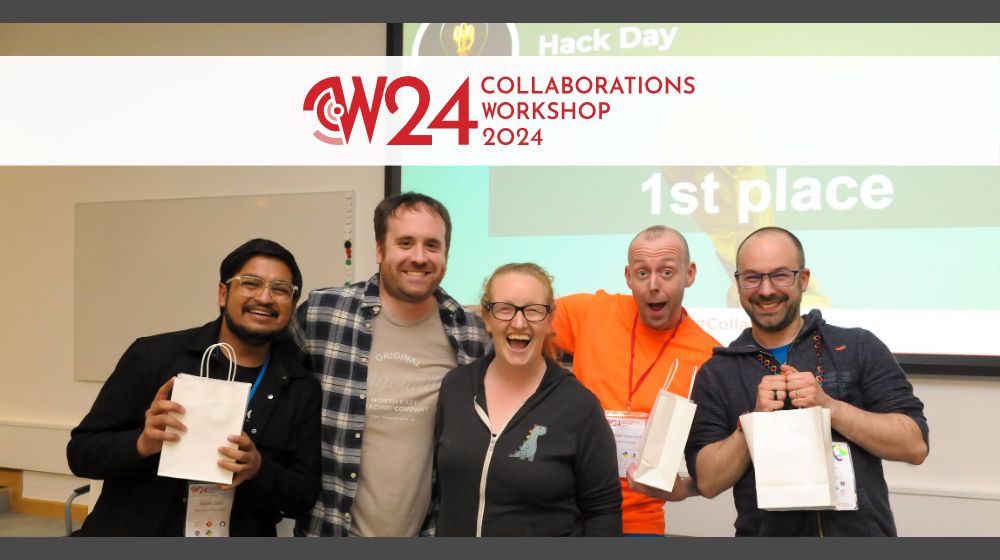
<p><img src="/assets/img/blog/task-management.jpg" alt="A photo of five people receiving a prize below the 2024 Collaborations Workshop logo." /></p>

<p>However, I had already decided to apply for the <a href="https://www.software.ac.uk/ssi-fellowship">SSI Fellowship</a>
to continue the conversation around mental health in the community. And so, when we split into groups on day two
to discuss ideas for the Hack Day, we went around the table and introduced ourselves. I mentioned my interest in
mental health and everyone was very supportive. I was surprised to find that many of them had been through similar experiences,
and we spent some time discussing the challenges we face and how they affect our mental health.</p>

<p>Then, someone mentioned that they had been using a task management framework to help them manage their workload,
and that it had helped them with their life-work balance and wellbeing. I was initially sceptical about
this idea, but then someone else mentioned that they had done something similar. So, we discussed it
a bit further and came up with an idea that became our suggestion for a hack day project.</p>

<h2 id="task-management-for-humans-as-self-care">Task Management for Humans as Self-Care</h2>

<p>The idea was to create a <a href="https://software-carpentry.org/">Software Carpentry</a>-style course that would introduce
a range of task management systems, with the focus being on value for the individual, rather than on value for their employer.</p>

<p>There were some key principles: The course would focus on self-care and life-work balance, rather than productivity.
It would introduce a range of task management systems, allowing participants to choose the elements that work best for them.
It wasn’t a case of “do it this way or your doing it wrong”, but rather “here are some options, try them out and see what works
for you”.</p>

<p>The idea won the top prize for the Ideas Session, and so it was selected as a project for the Hack Day. On day three,
we worked together to create a course outline with some example content and deployed it to the Carpentries Incubator.
The project went on to win the top Hack Day prize.</p>

<p>I think the fact that we go so much engagement, and that the project won both prizes, shows that the community understands
how important mental health is, and that they are willing to engage with such projects. It also showed that ideas can come
from unexpected places, and that great ideas can emerge when we share our experiences and work together.</p>

<h2 id="final-thoughts">Final Thoughts</h2>

<p>CW is always a great event, but CW24 was special. The engagement from everyone at the workshop was amazing.
The experience of working on this project inspired me to apply for the Fellowship, in the hope of creating similar projects and
engaging with the community to help support mental health. I am excited to see what other ideas will emerge from this wonderful
community. I also hope to bring together ideas like this on this website, so that the whole community can benefit from them.</p>

<h2 id="more">More</h2>

<ul>
  <li>You can read more about the project on the <a href="https://www.software.ac.uk/blog/task-management-humans-self-care">SSI website</a>.</li>
  <li>The course is available on the <a href="https://carpentries-incubator.github.io/task-management/aio.html">Carpentries Incubator</a>.</li>
</ul>

<p>This project is also listed on our <a href="/resources/projects">Projects and Communities page</a>. If you know
of any other projects that should be listed there, follow the instructions to submit them.</p>

<p>Thanks for reading.<br />
Take care of yourselves.</p>]]></content><author><name>mike_simpson</name></author><category term="projects" /><category term="self_care" /><summary type="html"><![CDATA[I’d been looking for ways to support mental health in the research software community, but I was struggling to come up with practical solutions. Then, a surprising idea emerged from a conversation at the SSI’s Collaborations Workshop in 2024.]]></summary><media:thumbnail xmlns:media="http://search.yahoo.com/mrss/" url="https://converse.mdsimpson.co.uk/task-management.jpg" /><media:content medium="image" url="https://converse.mdsimpson.co.uk/task-management.jpg" xmlns:media="http://search.yahoo.com/mrss/" /></entry><entry><title type="html">Working from Home</title><link href="https://converse.mdsimpson.co.uk/2025/03/23/working-from-home.html" rel="alternate" type="text/html" title="Working from Home" /><published>2025-03-23T00:00:00+00:00</published><updated>2025-03-23T00:00:00+00:00</updated><id>https://converse.mdsimpson.co.uk/2025/03/23/working-from-home</id><content type="html" xml:base="https://converse.mdsimpson.co.uk/2025/03/23/working-from-home.html"><![CDATA[<p>Working remotely has become part of our lives for many of us since the events of 2020. And, while it has its benefits,
working from home presents a unique set of challenges for our mental and physical health, so I’ve compiled a list of
tips to look after yourself while working remotely.</p>

<hr />

<p>Working from home has many advantages for everyone involved (if your employer trusts its staff and doesn’t treat
them like children, that is!). However, it is still important to look after yourself properly while you’re not in the office.
As someone who used to regularly work from home during my PhD and at least once per week before the pandemic,
I’ve compiled a list of tips for self-care in the home office.</p>

<p>This is based on <a href="https://mdsimpson.co.uk/2020/03/working-from-home-tips/">this blog post</a> that I wrote at the start of lockdown,
aiming to help my friends and colleagues adapt to ‘the new normal’. I’ve updated it and added a few additional notes based on my
experiences during and after the pandemic.</p>

<h2 id="tips">Tips</h2>

<p>I’ve broken down my advice for working from home into eight key points.</p>

<h3 id="1---get-dressed">1 - Get Dressed</h3>

<p>It can be tempting to stay in your PJs all day, or go for the classic working-from-home look of a shirt and PJ bottoms.
However, I find I am happier and more productive if I make the effort to have shower and get dressed before starting work.
This, like a lot of the tips on this list, is basically about acting as if you are going into the office, even if you aren’t.
Like with some of the other tips, it can also help break up the day and help set a boundary between ‘morning time’ and
‘work time’.</p>

<h3 id="2---get-away">2 - Get Away</h3>

<p>Just as you should in the office anyway, get away from your desk/workspace every so often. Walk around the house,
make a cuppa, do some little chores… Particularly if you’re struggling to concentrate or are stuck on a problem, you may find
that getting away for a few minutes and then coming back to it will really help. For example, I often sit in the living room
and watch an episode of something while I eat my lunch to help make sure I get a proper break.</p>

<h3 id="3---get-outside">3 - Get Outside</h3>

<p>Another obvious one, but one that can be easy to neglect. Even walking around the block for five minutes is better than
spending the whole day cooped up inside. This is another thing that can help break up the day. Why not walk around the block
“to work” in the morning, and then walk “back home” in the evening?  I recommend listening to Podcasts/Audiobooks while you
wander, if you need to feel like you’re “doing something” to make the most of that time.</p>

<p>If it’s raining (or you’re in lockdown!), at least be sure to open a window and/or the blinds to let some light and fresh air in.</p>

<h3 id="4---get-active">4 - Get Active</h3>

<p>It’s not just important to get away from your desk. You need exercise too. In addition to going outside for a walk,
consider improvising some short exercises using stuff around the house as weights, if you don’t want to buy any equipment.
I have an adjustable desk and a treadmill that I can set up under the desk, so I can walk while I’m working,
gaming, or taking a break.</p>

<h3 id="5---get-drinks--snacks">5 - Get Drinks &amp; Snacks</h3>

<p>Preferably healthy(ish) ones; you’ll be surprised how quickly an entire packet of chocolate biscuits can disappear when
you’re concentrating on something else! Remember to drink plenty of water/juice, as well as tea! Sometimes your body
confuses hunger and thirst, so drinking plenty is a good way to minimise unnecessary snacking and avoid putting on weight,
if you’re not getting the same amount of steps that you would if you were going into work (this helped when I was trying to lose
weight for my wedding).</p>

<h3 id="6---get-some-vitamin-d">6 - Get some Vitamin D</h3>

<p>The body creates vitamin D from direct sunlight on the skin when outdoors. It can help with tiredness, is good
for bones and can help the immune system. I was advised to take some Vitamin D supplements by my GP while I was suffering
from depression and insomnia. Boots do their own supplements, which are pretty cheap. I was advised to the 25μg dose, though
apparently 15μg is the recommended daily intake for adults.</p>

<h3 id="7---get-some-craic">7 - Get some <a href="https://en.wikipedia.org/wiki/Craic">Craic</a></h3>

<p>Even I - a borderline autistic, introvert - sometimes find that I need human interaction! I’ve found that podcasts/YouTube
videos can fill the gap, in a pinch, as can messenger, but a phone/video call every so often is better (and, of course,
meeting in person is best!). See if a friend can meet for lunch or a coffee. Checking in will help support your friends
and colleagues, and talking about stuff will help you feel better too, but just spending some time in other people’s company
can help lift your mood.</p>

<h3 id="8---get-focussed">8 - Get Focussed</h3>

<p>If you are actually knuckling down to work, try to avoid distractions. Don’t leave Facebook open in your browser or
have your phone right next to your keyboard. Sometimes it can be useful to turn off work emails and chat apps too, to allow
you to work without interruptions.
(For more on this, see my <a href="/2025/09/28/setting-boundaries">blog post about setting boundaries</a>.)</p>

<p>I find that listening to music – with a comfortable pair of headphones if you don’t want to disturb others
– is a good way to help me focus. You just have to find the right kind of music. For me, it’s songs that I am very familiar
with, or acoustic and instrumental tracks with no vocals that aren’t too distracting.</p>

<p>If you’re struggling to focus, work in 20 minute sprints, then switch to something else. Consider using a tool or app to help
keep track of all your tasks. You want a good life-work balance, and to be able to switch off from work at the end of the day,
and nothing will kill your personal life like feeling that you haven’t been productive enough! Ticking things off a to-do list
can also give you a sense of achievement and give you a little boost to your mood.</p>

<h2 id="final-thoughts">Final Thoughts</h2>

<p>Working from home can be challenging and your experience will vary depending on your personality and what policies, instructions
and advice your employer provides. But, a little self-care, determination and patience will help you adapt to this new style of
working. These are the tips that I have found most helpful and, hopefully, some of them will work for you.</p>

<p>Do you have any tips for working from home that I haven’t mentioned? Please consider submitting your own blog post via our
<a href="/contribute">Contribute page</a>.</p>

<p>Thanks for reading.<br />
Take care of yourselves.</p>]]></content><author><name>mike_simpson</name></author><category term="self-care" /><category term="self_care" /><summary type="html"><![CDATA[Working remotely has become part of our lives for many of us since the events of 2020. And, while it has its benefits, working from home presents a unique set of challenges for our mental and physical health, so I’ve compiled a list of tips to look after yourself while working remotely.]]></summary><media:thumbnail xmlns:media="http://search.yahoo.com/mrss/" url="https://converse.mdsimpson.co.uk/wfh.jpg" /><media:content medium="image" url="https://converse.mdsimpson.co.uk/wfh.jpg" xmlns:media="http://search.yahoo.com/mrss/" /></entry><entry><title type="html">How Writing Saved My Life</title><link href="https://converse.mdsimpson.co.uk/2025/03/20/writing.html" rel="alternate" type="text/html" title="How Writing Saved My Life" /><published>2025-03-20T00:00:00+00:00</published><updated>2025-03-20T00:00:00+00:00</updated><id>https://converse.mdsimpson.co.uk/2025/03/20/writing</id><content type="html" xml:base="https://converse.mdsimpson.co.uk/2025/03/20/writing.html"><![CDATA[<p>Yes, I know, it’s a melodramatic and clickbaity title. But it is definitely true that writing about my experiences
enabled me to process what I’d been through and allowed me to finally recover after years of struggling with depression,
anxiety and insomnia.</p>

<hr />

<h2 id="how-writing-saved-my-life">How Writing Saved My Life</h2>

<p>This is based on <a href="https://mdsimpson.co.uk/2022/01/how-writing-saved-my-life/">‘a blog post I wrote in 2022’</a>.
In that post, I talk about how I worked with my therapist to use my passion for writing to not only make the notes I was making
for my therapy sessions more interesting, but to turn them into a therapeutic tool themselves. You can, of course, read the
original post at the link above, but I wanted to reiterate some of the key points here.</p>

<p><img src="/assets/img/blog/writing.jpg" alt="" /></p>

<h2 id="writing-for-therapy">Writing for Therapy</h2>

<p>I’d tried traditional journalling before, but it didn’t really work for me. So, I tried a few different kinds of writing
to help me work through my thoughts and feelings. Again, these might not work for you, but maybe they will give you an idea
of something new to try, and, who knows, it might make a difference.</p>

<h3 id="on-becoming-a-father">On Becoming a Father</h3>

<p>I’ve written about this in <a href="/2025/03/14/backstory.html">in a previous post</a>, but I wrote a blog series called
<a href="https://mdsimpson.co.uk/i-am-your-father">‘I Am Your Father’</a>, chronicling my experience of becoming a dad for the first time
during lockdown (though I obviously didn’t know that it was going to become a lockdown parenting blog when I started it!).</p>

<p>It started as a light-hearted way to share the experience, primarily with our family and friends. I thought it would be fun to
write about the ups and downs of becoming a parent, and to share some of the funny and chaotic moments. After COVID hit,
I ended up writing about how we dealt with isolation, sleep deprivation, and becoming a parent with no outside support.
I also ended up discussing mental health. A lot!</p>

<p>As you can imagine, it was a difficult time, and it is still something that is difficult to reflect on.
However, I firmly believe that writing about it helped me to process what I was going through, to look for the
silver linings in all those dark clouds, and to focus on how we did the best we could in incredibly difficult circumstances.
So, I’m glad I stuck with it, even when things got really difficult.</p>

<p>Now, I realise that is, hopefully, a unique situation that you will not have to experience. But I hope it shows how writing
and reflecting - however difficult it might be - can be a useful tool for processing difficult experiences.</p>

<h3 id="out-of-my-head-and-onto-the-page">“Out of My Head and Onto the Page”</h3>

<p>This idea of using writing as a tool to process things can also be applied to less niche situations.
The pandemic isn’t the first time I’ve dealt with severe mental health issues. During a previous difficult period in my life,
I tried a range of different techniques and forms of therapy to try and help me begin to recover. As I said, traditional
journalling hadn’t worked for me. But I worked with the therapist to work out a different approach.</p>

<p>Part of the problem I had was that I would ruminate on things. The same thoughts and worries would keep going round
and round in my head. This would distract me from work and sleep, and prevented me from enjoying things. It also kept
dragging my mood down and making the whole situation worse.</p>

<p>Here are a few key quotes from the original post:</p>

<p><em>“I would write every few days about whatever topic had been dominating my thoughts, interspersed with bits of advice
from my sessions with Jo (my therapist). I would write structured essays on whatever had been on my mind,
as if I were writing a blog post (even though I never planned to actually share them).”</em></p>

<p><em>“By focusing on one thing at a time, I was able to break down my problems and begin to work through them.
Plus, by writing it all down, I was able to get the thoughts out of my head and onto the page,
which stopped me from obsessing over them quite so much.”</em></p>

<p>I found that if I wrote every-so-often about whatever topic had been dominating my thoughts, it helped me to
break the cycle and stop me from obsessing over them quite so much. Writing about them in a structured way,
as if I was writing a blog post - with an introduction, background, discussion and conclusions - helped me to
resolve these issues, which couldn’t happen when they were all jumbled up inside my head.</p>

<h3 id="telling-stories">Telling Stories</h3>

<p>I didn’t just just write non-fiction to help process things either. In 2019, I wrote a short story called ‘The Journey’
for a short-story competition by <a href="https://www.mind.org.uk/">Mind</a>. It was a fantastical tale, inspired by Greek and Norse
mythology, about a man battling literal demons, based on my experiences and on the things I’d worked through with my therapist.
In fact, the character of the Oracle in the story was based on her!</p>

<p>Again, it was not just retelling my story. I had to come up with things for the Oracle to say that would help the hero
on his journey, and ways for him to overcome the demons who were taunting him. And a lot of this was based on advice from
my therapist, and on the things that we’d worked through together.</p>

<p>The story was shortlisted by Mind and you can read it <a href="https://mdsimpson.co.uk/2020/05/the-journey/">on my website</a>.</p>

<h2 id="final-thoughts">Final Thoughts</h2>

<p>So, that’s how I was able to use writing as a therapeutic tool, to help me process and come to terms
with everything that happened to me. It may not work for you, but it’s something to consider if you’ve
got something going round and round in your mind and just want to be free of it.</p>

<p>Thanks for reading.<br />
Take care of yourselves.</p>]]></content><author><name>mike_simpson</name></author><category term="self-care" /><category term="anxiety" /><category term="depression" /><category term="burnout" /><summary type="html"><![CDATA[Yes, I know, it’s a melodramatic and clickbaity title. But it is definitely true that writing about my experiences enabled me to process what I’d been through and allowed me to finally recover after years of struggling with depression, anxiety and insomnia.]]></summary><media:thumbnail xmlns:media="http://search.yahoo.com/mrss/" url="https://converse.mdsimpson.co.uk/writing.jpg" /><media:content medium="image" url="https://converse.mdsimpson.co.uk/writing.jpg" xmlns:media="http://search.yahoo.com/mrss/" /></entry></feed>